I'm still working on some configuration, but I've started posting so if all four of you still want to follow my blog, you might want to head over there.
Friday, October 12, 2012
I've moved to hackerbee.com!
I've gotten serious about building the bee hive datalogger and I've never been particularly fond of the name here, so I've moved to hackerbee.com
I'm still working on some configuration, but I've started posting so if all four of you still want to follow my blog, you might want to head over there.
I'm still working on some configuration, but I've started posting so if all four of you still want to follow my blog, you might want to head over there.


Wednesday, October 3, 2012
Some awesome temperature logging projects!
I found some great temperature logging projects this week -- one linked on hackaday.com, (http://www.maxjusticz.com/honey-bee-tracking-box/ ) and another linked in the comments of the first (http://mietz.imkerforum.de/the_idea.html ). This is great stuff -- the first is incredibly finished with a waterproof seal and a solar panel directly on top of the enclosure while the second has an incredible 88 sensors spread out over 11 frames of a single-box observation hive! Here's the incredible video of temperature within the hive:
This is incredible data to see as it suggests that the lower resolution 9 points between each box I'd planned is enough to catch most of what's going on in a bee hive. Sure, I might miss the occasional deviation, but if the bees reliably cluster around the brood nest as they seem to in inspections and as evidenced here, adding 10x more sensors is probably not going to give me much more information.
Heck, even 9 sensors per box is probably way too much information, but I'm hoping to track the hive cluster over winter next winter (the winter after next summer) and I'm pretty sure one sensor per box won't be enough.
Anyway, great stuff makes me want to get mine working even more! I suppose that means I hurry up and draw a final schematic so I can solder down all the components without making time-consuming mistakes!
Heck, even 9 sensors per box is probably way too much information, but I'm hoping to track the hive cluster over winter next winter (the winter after next summer) and I'm pretty sure one sensor per box won't be enough.
Anyway, great stuff makes me want to get mine working even more! I suppose that means I hurry up and draw a final schematic so I can solder down all the components without making time-consuming mistakes!
Tuesday, October 2, 2012
Meeting about bee hive monitoring
I met a guy from Portland yesterday (he goes by "Hydronics" online) to talk about data logging in bee hives. We talked about his great work building a device that counts bees going in and out of the hive.
This is a long summary of our projects and some of our ideas -- sorry if it's not interesting (this is your obligatory "wonkish" warning), but if you have interest in bees, electronics, or measuring bee hive data, I welcome any advice, criticism or comments!
The device uses a microcontroller to poll 44 little IR LED proximity sensors on 22 different gates (or tunnels) and measures whether they're going in or out of the hive by watching to see which of two sensors is triggered first through a gate. He saw some amazing things in the data -- like some spikes at 4:00 PM on a few different days that looked like orienting and some in/out spikes that could possibly correlate with a particular food or water source if they're statistically significant (i.e. not just us finding patterns in random noise).
One of the major issues I've had with his design is that it's power hungry. It draws 75 mA which is a lot of power when you're trying to run the thing off a solar panel and battery! We talked about a bunch of ways to improve the design. He's already tried turning off half the LEDs and using just one LED to drive two sensors in each gate. I think he might have to modify the board layout to put the active LED roughly equally spaced between the two sensors (one is further from the LED in his current design). This would cut the power consumption roughly in half. He could also pulse the LEDs -- turning on only the ones being measured at one time. I showed him some spec sheets of IR proximity sensors designed for use in smartphones and ebooks. They are designed for ultra-low power consumption and can run on a few dozen microamps when pulsing at 10 Hz or so. Of course, the integrated packages are $4 each, but we could cut the price significantly by engineering a similar pulsed solution that meets our needs. As always, you can spend time or money, but it's hard to get exactly what you want for cheap in a ready-made package!
Hydronics also mentioned that he thought he might be able to get the system working with ambient light -- possibly using UV or IR (or both?) so it works even when the sky's cloudy. Heck, with a cheap diffuser, you might be able to use any wavelength you wanted! This would eliminate almost all the current draw, but it might sacrifice sensitivity. The system would likely fail under certain lighting conditions like when the sun is shining directly into the hive entrance or when the sky is really cloudy. Still, paired with external ambient light sensors and using a diffused slit and two more light sensors in each black-painted gate, I think there's a decent chance you could calibrate the system to work in most lighting conditions! I'm excited to look into engineering and testing LED-free gates!
Ultimately, while 100% detection will always be a goal, the kind of data we're looking for can tolerate significant noise or downtime.
On a separate subject, I mentioned some research I've come across that tracked bees in and out of the hive with radar or with cameras. There have even been some attempts to glue radio trackers to individual bees, although this is obviously tedious! I wondered if we could put small dots of retroreflective material (3M makes some great beaded and corner-cube tapes) that would give incredible contrast in all lighting conditions for tracking with a camera. This might be further in the future (certainly after the winter when the bees rarely fly outside of the hive) but it could allow wide-angle tracking of tagged bees over a very large area with a relatively low-tech video camera! Tiny bits of tape could be pre-cut for tagging, and while it wouldn't be quite as effective, I also wonder if we could simply sprinkle glass beads onto some bees or develop an adhesive including glass beads that could provide enough retro-reflection to allow tracking. Unfortunately, I think the bead idea may require metal-coating of one side of the beads, but maybe all the beads could be half coated ahead of time and enough would be oriented the right way in the adhesive that they'd provide a good signal?
Finally, we talked about my hive logging project. My specs are always changing, but currently I am planning to put an array of 9 temperature sensors in a thin frame on top of each box for 3D mapping of temperature in the hive as well as monitoring ambient temperature and my circuit temperature (for debugging and tracking). I'll probably also add a humidity sensor, although I've never seen anybody come up with particularly useful correlations between humidity and bee behavior. I'll be installing a microcontroller inside an industrial postal scale and streaming the data back to the internet through an XBee radio and a ConnectPort X2. We've both also been looking at logging to an SD card with a real time clock for timestamps. If my radio logging isn't reliable enough, I might fall back on an SD card, but it's a bit of a hassle to get into the hive to retrieve the data!
Hopefully I'll be able to build my own bee counter for next year's season as well. Who knows how effective it'll be at first, and it's much lower priority than getting the weight and temperatures, but if we can build a good remote solution, it could be an incredible addition to a bee hive monitoring package!
This is a long summary of our projects and some of our ideas -- sorry if it's not interesting (this is your obligatory "wonkish" warning), but if you have interest in bees, electronics, or measuring bee hive data, I welcome any advice, criticism or comments!
The device uses a microcontroller to poll 44 little IR LED proximity sensors on 22 different gates (or tunnels) and measures whether they're going in or out of the hive by watching to see which of two sensors is triggered first through a gate. He saw some amazing things in the data -- like some spikes at 4:00 PM on a few different days that looked like orienting and some in/out spikes that could possibly correlate with a particular food or water source if they're statistically significant (i.e. not just us finding patterns in random noise).
One of the major issues I've had with his design is that it's power hungry. It draws 75 mA which is a lot of power when you're trying to run the thing off a solar panel and battery! We talked about a bunch of ways to improve the design. He's already tried turning off half the LEDs and using just one LED to drive two sensors in each gate. I think he might have to modify the board layout to put the active LED roughly equally spaced between the two sensors (one is further from the LED in his current design). This would cut the power consumption roughly in half. He could also pulse the LEDs -- turning on only the ones being measured at one time. I showed him some spec sheets of IR proximity sensors designed for use in smartphones and ebooks. They are designed for ultra-low power consumption and can run on a few dozen microamps when pulsing at 10 Hz or so. Of course, the integrated packages are $4 each, but we could cut the price significantly by engineering a similar pulsed solution that meets our needs. As always, you can spend time or money, but it's hard to get exactly what you want for cheap in a ready-made package!
Hydronics also mentioned that he thought he might be able to get the system working with ambient light -- possibly using UV or IR (or both?) so it works even when the sky's cloudy. Heck, with a cheap diffuser, you might be able to use any wavelength you wanted! This would eliminate almost all the current draw, but it might sacrifice sensitivity. The system would likely fail under certain lighting conditions like when the sun is shining directly into the hive entrance or when the sky is really cloudy. Still, paired with external ambient light sensors and using a diffused slit and two more light sensors in each black-painted gate, I think there's a decent chance you could calibrate the system to work in most lighting conditions! I'm excited to look into engineering and testing LED-free gates!
Ultimately, while 100% detection will always be a goal, the kind of data we're looking for can tolerate significant noise or downtime.
On a separate subject, I mentioned some research I've come across that tracked bees in and out of the hive with radar or with cameras. There have even been some attempts to glue radio trackers to individual bees, although this is obviously tedious! I wondered if we could put small dots of retroreflective material (3M makes some great beaded and corner-cube tapes) that would give incredible contrast in all lighting conditions for tracking with a camera. This might be further in the future (certainly after the winter when the bees rarely fly outside of the hive) but it could allow wide-angle tracking of tagged bees over a very large area with a relatively low-tech video camera! Tiny bits of tape could be pre-cut for tagging, and while it wouldn't be quite as effective, I also wonder if we could simply sprinkle glass beads onto some bees or develop an adhesive including glass beads that could provide enough retro-reflection to allow tracking. Unfortunately, I think the bead idea may require metal-coating of one side of the beads, but maybe all the beads could be half coated ahead of time and enough would be oriented the right way in the adhesive that they'd provide a good signal?
Finally, we talked about my hive logging project. My specs are always changing, but currently I am planning to put an array of 9 temperature sensors in a thin frame on top of each box for 3D mapping of temperature in the hive as well as monitoring ambient temperature and my circuit temperature (for debugging and tracking). I'll probably also add a humidity sensor, although I've never seen anybody come up with particularly useful correlations between humidity and bee behavior. I'll be installing a microcontroller inside an industrial postal scale and streaming the data back to the internet through an XBee radio and a ConnectPort X2. We've both also been looking at logging to an SD card with a real time clock for timestamps. If my radio logging isn't reliable enough, I might fall back on an SD card, but it's a bit of a hassle to get into the hive to retrieve the data!
Hopefully I'll be able to build my own bee counter for next year's season as well. Who knows how effective it'll be at first, and it's much lower priority than getting the weight and temperatures, but if we can build a good remote solution, it could be an incredible addition to a bee hive monitoring package!
Tuesday, September 11, 2012
Honey Harvest!
Two weekends ago, I pulled honey off the hives. Two hives were very strong and yielded 2-3 medium supers of honey each (about 40 pounds). My wife and I got really hot and dehydrated so we decided to stop and I came back later to find that the last hive was queenless. It's still got 20-30 thousand bees, but it's not strong, and I only pulled about 1 medium super off (all they had).
Without a queen, the hive will die soon, and this close to winter, there's no point in introducing a queen who won't have enough time before the cold to build up hive population. I'll tear down the hive for storage when the temperatures get a bit more reasonable.
I put sugar-water feeders on the two strong queenright colonies, and I'll check sometime this week to see how they're taking it.
At the Acreage, we also pulled between one and two boxes of honey. That's pretty disappointing, but it might be inevitable due to the surrounding wetlands. My dad will expand to other locations when he has more time (i.e. retired) but until then, it might just be a low-yielding hobby site.
We left the honey in the honey room for a week with a dehumidifier at high temperature to ensure the water content was low enough to be "honey" (18.6% or less water) and extracted the honey in a centrifuge last weekend. All together, we got about 200 pounds. My wife has sold a couple dozen pounds before it's even been bottled, so if you want some, let us know ASAP ($7 per lb.).
In other news, I'm deep into my hivelogger project. It'll log hive weight, temperature (at nine points per box) and ambient temperature directly to a google document from which I can graph the data in real time. I'll post more on that when I've got it fully built, and I'll put a guide up on Instructables.
Saturday, April 28, 2012
Spring Inspections
The Lair is back up to 3 hives and the Acreage is back to 5 or so after we lost around 60% last winter. This week, I found eggs in all three hives, so it looks like all 3 hives are gearing up for summer.
The middle hive that made it through the winter ended the winter with about 50 pounds of honey and it's going like crazy! I've had to keep adding space, and the queen is laying so frequently she keeps 20-30 frames of brood cooking at any one time! They're also obviously bringing in honey, and while it's been a bit difficult for me to track recently since it's spread out throughout the 9 medium boxes, I think they're going to shoot into higher supers very soon. Since the hive is higher than I am, and the queen has decided to lay in some of the higher boxes, I'm going to have to spend a few hours sorting it out at some point (putting all the brood at the bottom and honey at the top) and I'll probably have to steal honey at least twice to keep it at a manageable height.
It's not a bad problem to have, but as I'm selling my house and have to move in a few weeks, I'm going to have to let the bees run on autopilot for a while. I'll try to give them plenty of space to discourage swarming, but that might be an inevitable consequence of my move.
Sunday, February 26, 2012
Bees still buzzing!
It looks like I forgot to blog about wintering the bees, but it's pretty straightforward so here's what happened. It turns out that there's not a lot you can do to help the bees make it through winter. Insulation sounds like a good idea, but it turns out that the bees require constant airflow through the hives to remove moisture so the hives stay only a few degrees above the outside temperature all winter long. The worker bees "shiver" by moving their wing muscles without moving their wings to generate heat and keep the little cluster of bees warm enough to make it through the winter, but they only keep their little cluster warm, not the whole hive. On warmer days, they move around to follow honey stores, but they can't move far when it's really cold so it is important for a beekeeper to check the hives later in the winter (now) to shift around honey stores if the bees eat themselves into a corner and can't get to honey just a few inches away in a cold snap!
Because there's not much that can help the bees through the winter, it's not too difficult to get them ready. The biggest concern is that they have enough honey to make it through the winter, and I covered that by simply being very conservative about how much honey I took from the hive. Then you treat any diseases or parasites -- usually Varroa Mites, but since I didn't note any problematic infestation I didn't have to worry about that either.
Finally, in November, I added a sheet of particleboard to help wick moisture out of the hives and covered the hives in black wax-coated cardboard. The cardboard heats up in the sun and might help to cut the wind a bit. Here's a picture of the hives after I wrapped them up for the winter.

Late-Winter Inspection
On February 9, on a warm day above 40F, I drove out to the Lair to check the hives. I gave a light tap to each hive and heard buzzing from the first two, but silence from the last. It turned out that the third hive, the weakest of the three all last year, had died relatively early in the winter. Below you can see the remains of a cluster with bees holding onto or with their heads stuck into the comb. They are surrounded by empty comb so it is possible that they simply ate all the nearby honey and couldn't move far enough during a few cold days to find more food, but because they were still in the bottom two medium boxes out of four, I suspect they were also weak -- perhaps from Varroa.

The other two hives were doing very well and were clustered toward the South side of the top two boxes in both hives. I took the top two boxes full of honey from the dead hive and added them to the other hive both to prevent the honey from going to waste (they're likely to mold if they stay unattended after it warms up) and to give the bees one more box of solid honey they can move up into in case we see more cold weather.
Below you can see a somewhat blurry picture of the left hive's cluster. I only lifted up the box for a few seconds to see where they were, and while it's a bit worrysome to have the cluster all the way over on the side, I think it helps a lot that I could add a box of honey above them so they'll have room to move to nearby stores even if it gets very cold.
Another thing a beekeeper can do is move honey around within the boxes -- perhaps moving honey from the left side to a slot right next to the cluster, but the more you disturb the cluster, the more the bees will get stressed and cold so I was satisfied with adding the two boxes on top.

I plan to go back next weekend with some or all of my family to collect the two empty boxes from the dead hive. They still have some honey (maybe 10-20 pounds) and I want to dry them out in my garage before they get regularly warm enough to mold. In late March when the weather's good and the queens are laying eggs like mad, I'll split one or both of the living hives and buy a new queen to lead the new hive(s). The bees will all appreciate the honey left on the hives and they'll have a head start on building up stores for me to steal next Fall!
Because there's not much that can help the bees through the winter, it's not too difficult to get them ready. The biggest concern is that they have enough honey to make it through the winter, and I covered that by simply being very conservative about how much honey I took from the hive. Then you treat any diseases or parasites -- usually Varroa Mites, but since I didn't note any problematic infestation I didn't have to worry about that either.
Finally, in November, I added a sheet of particleboard to help wick moisture out of the hives and covered the hives in black wax-coated cardboard. The cardboard heats up in the sun and might help to cut the wind a bit. Here's a picture of the hives after I wrapped them up for the winter.

Late-Winter Inspection
On February 9, on a warm day above 40F, I drove out to the Lair to check the hives. I gave a light tap to each hive and heard buzzing from the first two, but silence from the last. It turned out that the third hive, the weakest of the three all last year, had died relatively early in the winter. Below you can see the remains of a cluster with bees holding onto or with their heads stuck into the comb. They are surrounded by empty comb so it is possible that they simply ate all the nearby honey and couldn't move far enough during a few cold days to find more food, but because they were still in the bottom two medium boxes out of four, I suspect they were also weak -- perhaps from Varroa.

The other two hives were doing very well and were clustered toward the South side of the top two boxes in both hives. I took the top two boxes full of honey from the dead hive and added them to the other hive both to prevent the honey from going to waste (they're likely to mold if they stay unattended after it warms up) and to give the bees one more box of solid honey they can move up into in case we see more cold weather.
Below you can see a somewhat blurry picture of the left hive's cluster. I only lifted up the box for a few seconds to see where they were, and while it's a bit worrysome to have the cluster all the way over on the side, I think it helps a lot that I could add a box of honey above them so they'll have room to move to nearby stores even if it gets very cold.
Another thing a beekeeper can do is move honey around within the boxes -- perhaps moving honey from the left side to a slot right next to the cluster, but the more you disturb the cluster, the more the bees will get stressed and cold so I was satisfied with adding the two boxes on top.

I plan to go back next weekend with some or all of my family to collect the two empty boxes from the dead hive. They still have some honey (maybe 10-20 pounds) and I want to dry them out in my garage before they get regularly warm enough to mold. In late March when the weather's good and the queens are laying eggs like mad, I'll split one or both of the living hives and buy a new queen to lead the new hive(s). The bees will all appreciate the honey left on the hives and they'll have a head start on building up stores for me to steal next Fall!
Wednesday, August 10, 2011
Picture from the Lair!
Yesterday, I visited the Lair to make sure that they hadn't run out of room, and I think all three hives have just the right amount of room left so I didn't add any extra supers. Here's the picture showing the final height of the three hives:


On the left side, the top super is about a third full, the middle hive (significantly taller than me now) is around 70% finished with the 8th super and hasn't significantly started on the 9th, and the right hive is only around 50% finished with the 5th super.
It was only 4 days since I added the top boxes, so with any luck and good weather, the nectar will continue to flow and the top supers will get filled out. If not, I'll be stuck with some partially-filled frames, but I can either swap some full, lower frames with the partly-filled ones or use the partial frames to bolster some of our weaker hives at the Acreage (probably both). I want 2-3 supers full of honey going into winter, and while I can potentially feed the hives sugar-water after we harvest on August 21, it will be a hassle and I'd prefer to simply let the bees backfill the lower boxes as winter approaches. I hope to have around 100 lbs of honey left for the bees when they go into winter which translates to about 3 Medium supers at a low estimate of 35 lbs apiece.
Friday, August 5, 2011
Lair Update
Over a week ago, on a Tuesday morning, once again I found that the center hive had totally filled the top super (after only about a week!) and the two outer hives had just barely started thinking about working on their 5th super.
As before, I took the untouched 5th super from the right hive and placed it on the center hive right away, and then came back on Thursday after my dad delivered two more supers now empty from the honey extraction for the center and right hives. Unfortunately, I end up rather distracted when I'm at the Lair, and while Jen (a Lair native) took some great pictures of the hives, I forgot, so I can't show how the middle hive has grown to a bit taller than me!
Just yesterday (August 4) I visited the hives again with another 2 supers. I quickly inspected the left hive and found that boxes 4 and 5 were totally drawn out and mostly full of honey. I dug down deeper into the hive and found beautiful brood patterns (seen below) and found a frame of eggs and larvae proving that the queen was there within the last 3 days.

I was short on time and I'd hurt my shoulder earlier in the week (trying to start my lawnmower) so I didn't inspect the other two hives, but I checked the top boxes and found that the 7th box was full of honey and largely capped, and the 8th box was 80% drawn out, and probably 60 or 70% full of curing nectar. I added a 9th super to the middle hive to keep them collecting as long as the nectar flow continues.
Here's a picture of a fully capped frame of honey on the very edge of the brood nest. I'm not 100% sure, but I believe this was from the 3rd frame from the end in the 4th box from the ground. I didn't see any brood in the 5th or higher boxes so harvesting should go very well.

The right hive is still the slowest, having drawn out the 5th box only about 60%. I will bring 2-3 supers on Monday or Tuesday to add room to the middle and right hives, and possibly the left hive if they've made good progress in the half-week since I last added another super.
I think adding supers to just the center and right hives will be sufficient. I might lose out on 20-50 pounds of honey that they'd otherwise pack away, but if you provide an excess of space right up to the end of the nectar flow, you have to deal with the large number of partially-drawn and partially-filled frames in the top super. You can steal some honey from lower down and fill the partially-filled frames by feeding the bees sugar water, but since I can't be out at the lair twice a week, I'd like to avoid fall feeding if I can.
That means I'll have to harvest maybe 25-50 lbs (1-2 boxes) less honey than I otherwise could, and letting the bees fill up the hives to the top might mean they don't collect a similar amount, but at 25+ lbs per box, I'm already looking at over 200 lbs of honey from these two hives, and since my distribution network only had to handle 25 lbs or so last year, I'm not sure I'll notice the "loss."
Assuming good weather, we've tentatively planned to harvest the honey (brush the bees off each frame so that the bee-free capped honey can be transported to the Acreage and extracted) on the morning of Sunday, August 21. Then I may start extracting in the evening, or wait until Monday evening after work to uncap and extract the honey from the honeycomb.
As before, I took the untouched 5th super from the right hive and placed it on the center hive right away, and then came back on Thursday after my dad delivered two more supers now empty from the honey extraction for the center and right hives. Unfortunately, I end up rather distracted when I'm at the Lair, and while Jen (a Lair native) took some great pictures of the hives, I forgot, so I can't show how the middle hive has grown to a bit taller than me!
Just yesterday (August 4) I visited the hives again with another 2 supers. I quickly inspected the left hive and found that boxes 4 and 5 were totally drawn out and mostly full of honey. I dug down deeper into the hive and found beautiful brood patterns (seen below) and found a frame of eggs and larvae proving that the queen was there within the last 3 days.

I was short on time and I'd hurt my shoulder earlier in the week (trying to start my lawnmower) so I didn't inspect the other two hives, but I checked the top boxes and found that the 7th box was full of honey and largely capped, and the 8th box was 80% drawn out, and probably 60 or 70% full of curing nectar. I added a 9th super to the middle hive to keep them collecting as long as the nectar flow continues.
Here's a picture of a fully capped frame of honey on the very edge of the brood nest. I'm not 100% sure, but I believe this was from the 3rd frame from the end in the 4th box from the ground. I didn't see any brood in the 5th or higher boxes so harvesting should go very well.

The right hive is still the slowest, having drawn out the 5th box only about 60%. I will bring 2-3 supers on Monday or Tuesday to add room to the middle and right hives, and possibly the left hive if they've made good progress in the half-week since I last added another super.
I think adding supers to just the center and right hives will be sufficient. I might lose out on 20-50 pounds of honey that they'd otherwise pack away, but if you provide an excess of space right up to the end of the nectar flow, you have to deal with the large number of partially-drawn and partially-filled frames in the top super. You can steal some honey from lower down and fill the partially-filled frames by feeding the bees sugar water, but since I can't be out at the lair twice a week, I'd like to avoid fall feeding if I can.
That means I'll have to harvest maybe 25-50 lbs (1-2 boxes) less honey than I otherwise could, and letting the bees fill up the hives to the top might mean they don't collect a similar amount, but at 25+ lbs per box, I'm already looking at over 200 lbs of honey from these two hives, and since my distribution network only had to handle 25 lbs or so last year, I'm not sure I'll notice the "loss."
Assuming good weather, we've tentatively planned to harvest the honey (brush the bees off each frame so that the bee-free capped honey can be transported to the Acreage and extracted) on the morning of Sunday, August 21. Then I may start extracting in the evening, or wait until Monday evening after work to uncap and extract the honey from the honeycomb.
Tuesday, July 26, 2011
Honey harvest!
First, some bad news. One of my dad's 6 hives was totally robbed dry by some of the other hives, and we've seen evidence of some robbing in both my hives. Also, while we got 10 or so lbs of honey from Jo, most of the honey I had been counting on there was consumed by the drones that have overwhelmed the hive. With an unfertilized queen (or possibly a laying worker) the hive will probably starve before winter, and certainly hasn't got a chance of making it until spring as the queen isn't laying workers, and unfertilized eggs (drones) can't become queens.
That said, Megmight yield some small amount of honey, there are a couple other hives at the acreage that have between 100 and 200 lbs of honey that is currently being capped and cured, and last weekend, we were able to harvest 100 lbs from one of the better-producing hives along with whatever we could salvage from Meg!
The Harvest


Then my mum took over and spun the frames until all the honey came out (about 1 or 2 minutes of consistent turning for 6 frames). Note that in this picture, we had tried tangential extraction with only three frames. It worked, but it took a lot more time and didn't seem to be more effective. Normally the 6 wooden frames would be arranged like spokes instead of around the edge of the centrifuge.
My dad and I took turns on the extractor, but being male, we were a bit overzealous and the next picture shows how too much force will "blow out" all the wax in a frame so the wax has to be replaced -- a huge inconvenience for both us and the bees!


That said, Megmight yield some small amount of honey, there are a couple other hives at the acreage that have between 100 and 200 lbs of honey that is currently being capped and cured, and last weekend, we were able to harvest 100 lbs from one of the better-producing hives along with whatever we could salvage from Meg!
The Harvest
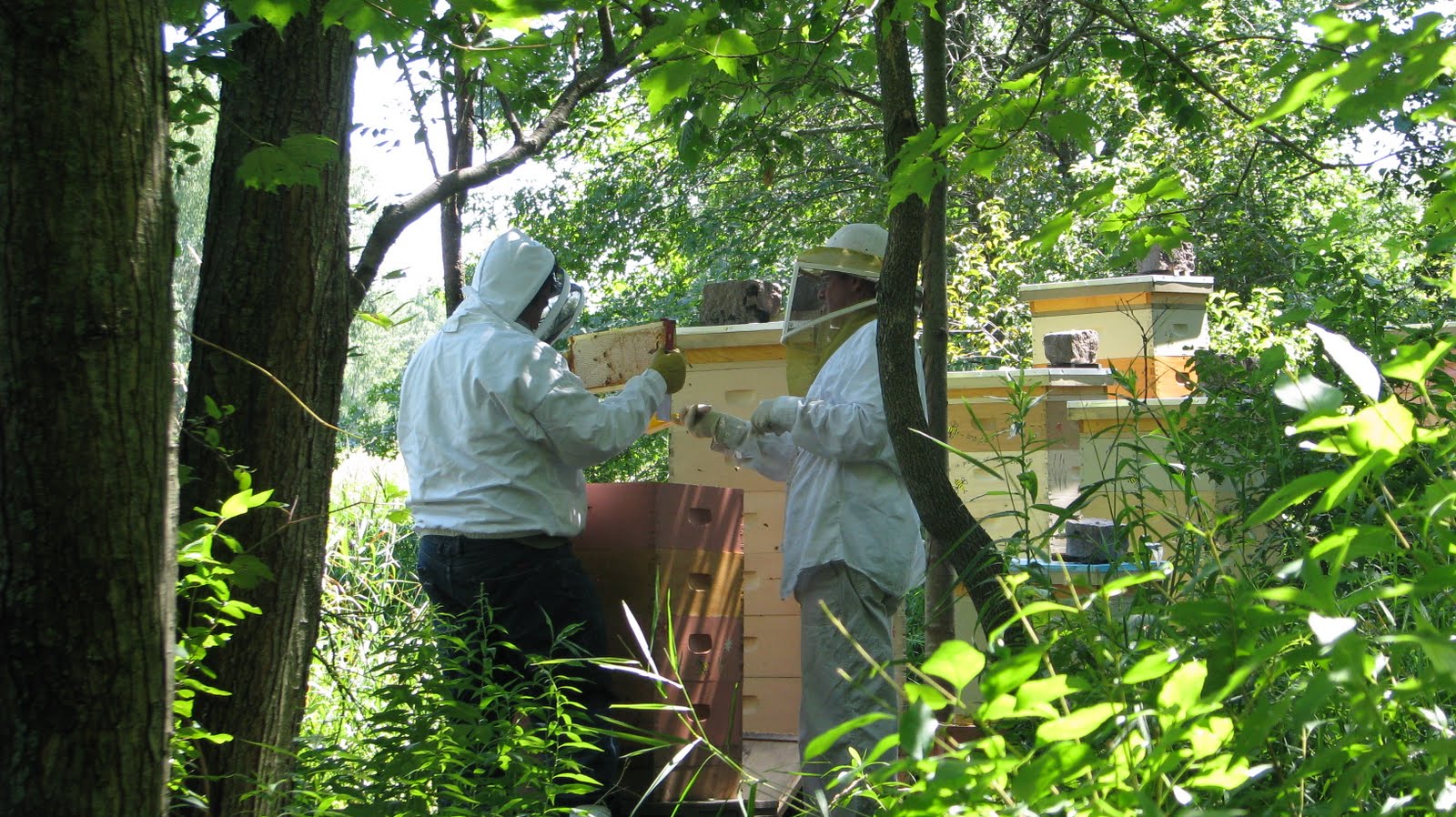
Unfortunately it always fails to occur to me to take pictures of the apiary -- really a clearing with 7 or so hives placed on the Westish edge -- but this picture from the back shows many of the hives. Jo is in the front -- the hive with the bad queen -- and in the picture I'm selecting the fullest frames for harvest. Second is Meg, and while we saw maybe 10-15 frames of capped honey in Meg, it was only 60% capped so we left it for the bees to finish processing. On Sunday we noticed some robbing from Meg, so depending on how bad it was, all her honey might now be in one of the other hives, but we'll find out in late August when we harvest again.
The rest of the hives are "my dad's" although that distinction may become arbitrary as it makes more sense to divide up hives by apiary than person (remember "my" hives started at a different location). They're named by color, but some colors are similar or being repeated so even my parents can't seem to keep them straight!
We took three and a half supers with about 8 frames each (normally they hold 9 or 10 but I like a little extra space when I'm dealing with heavy, sticky frames full of honey) back to the garage and got to work cutting the wax capping off the cells of honey and extracting the honey with my dad's new toy, a Maxant 6-frame radial extractor!


Above, my dad (left) and I are cutting the wax off the frames. When the bees evaporate enough water so the honey is less than about 18.6% water and will last forever (or more practically, at least until the next summer) without fermenting, the bees seal each cell containing honey with a thin wax cap. We cut off the caps and any comb that extends beyond the edge of the wooden frame (releasing a lot of tasty honey in the process) so that the honey will flow out when turned in the centrifuge!


Above, left, is a frame of capped honey with all the wax cappings and honey caught in a maple syrup pan, and an uncapped frame of gooey honey on the right. We looked everywhere for the uncapping tank we had last year, but it was nowhere to be found!

Then my mum took over and spun the frames until all the honey came out (about 1 or 2 minutes of consistent turning for 6 frames). Note that in this picture, we had tried tangential extraction with only three frames. It worked, but it took a lot more time and didn't seem to be more effective. Normally the 6 wooden frames would be arranged like spokes instead of around the edge of the centrifuge.
My dad and I took turns on the extractor, but being male, we were a bit overzealous and the next picture shows how too much force will "blow out" all the wax in a frame so the wax has to be replaced -- a huge inconvenience for both us and the bees!

The honey and some wax that fell off in the centrifuge is poured out the bottom of the extractor into a couple of metal sieves to strain out wax and any other debris. Some people filter their honey even further to remove even some barely-visible clumps of pollen (usually still leaving lots of pollen, just not in clumps), but our honey turns out quite clear (when it isn't full of bubbles from pouring the dregs of a pail anyway) and while I'm skeptical of claims for amazing health benefits from strained but unfiltered honey, I don't see any reason to add another complex step. I might change my mind if all the honey starts crystallizing right away one year, but for now, I just strain my honey.

Altogether we filled two 5-gallon pails about 80% full (one for Rachel and I, and one for my parents) for a total of 88 pounds. Here's most of the 46 pounds I bottled last night in my kitchen!

The jar in the front, left, was the last jar I bottled -- you can tell it is absolutely FULL of bubbles while the rest of the honey is darker and more translucent.
So... anybody want some honey? I think I'm limited to about 25 lbs for sale right now until our next harvest (but my parents have more, so feel to poke them too!)
Monday, July 18, 2011
I visited the Lair today to deliver one more super to replace the one I'd transfered to the super-productive hive. The bees were already "bearding" at 7:00 this morning as the high heat index of 85 starts creeping up to a high of 118. It's hard to cure honey or even evaporate water to cool the hive when it's so incredibly hot and humid. There won't be much nectar collection today as the bees and flowers both just try to wait out the heat.

The two outer hives were about 80% finished with their 4th box, and the center hive was drawing out about 30-50% of their 6th box, although as I was in a hurry and the bees were cranky on such a hot and humid morning, I just peered in through the top instead of examining any frames more closely. When the heat subsides a bit, I'll need to spend some serious time on a full inspection in the next couple weeks.
Sunday, July 17, 2011
Queenless Resolution
Meg and Jo both have around 2.5 fully capped boxes of honey! However, only one of them is thriving with a new queen. Below is a picture of Meg's queen -- she's been laying some pretty good patterns, and I don't foresee any problems going into the winter.

I did notice more brood cells ripped open with Varroa mites than usual. This is exactly what I got Minnesota Hygenic queens for, although I guess I can't really be certain of the queen genetics now that the queen has been replaced at least once.
Jo, on the other hand, does appear to have a new queen (there are no signs of laying workers) but she's laying mostly drones and I noticed 3 queen cells in the hive. Maybe they're trying to supercede, but the population isn't up to peak nectar gathering any more.

We're going to wait another week or so to decide what to do. Maybe we'll combine Jo with a swarm my dad caught at the acreage, or maybe we'll just take all their honey and restart with a split in the spring.
At the Lair, I had a quick look under the covers, and found that while the two outer hives had just barely started drawing out the 5th box (and were only half done with the 4th), the middle hive had drawn out every square inch of space in all 5 boxes! Since I didn't have any extra supers on hand, I simply moved one from the right hive to the middle hive to even out the space. I'll stop over there tomorrow or the next day to drop off one more super so all 3 hives have extra space. As a related note, frames with wax should not be left outside in a hot car in the sun where the temperature can exceed the melting point of wax.
Here's a picture of the lair after my manipulations. I should really come up with names for these hives, but now that I'm having trouble with Meg and Jo (I'm sure I'm screwing them up now and again) I'm not sure what kind of naming convention I should look for. Maybe just serial numbers?


I did notice more brood cells ripped open with Varroa mites than usual. This is exactly what I got Minnesota Hygenic queens for, although I guess I can't really be certain of the queen genetics now that the queen has been replaced at least once.
Jo, on the other hand, does appear to have a new queen (there are no signs of laying workers) but she's laying mostly drones and I noticed 3 queen cells in the hive. Maybe they're trying to supercede, but the population isn't up to peak nectar gathering any more.

We're going to wait another week or so to decide what to do. Maybe we'll combine Jo with a swarm my dad caught at the acreage, or maybe we'll just take all their honey and restart with a split in the spring.
At the Lair, I had a quick look under the covers, and found that while the two outer hives had just barely started drawing out the 5th box (and were only half done with the 4th), the middle hive had drawn out every square inch of space in all 5 boxes! Since I didn't have any extra supers on hand, I simply moved one from the right hive to the middle hive to even out the space. I'll stop over there tomorrow or the next day to drop off one more super so all 3 hives have extra space. As a related note, frames with wax should not be left outside in a hot car in the sun where the temperature can exceed the melting point of wax.
Here's a picture of the lair after my manipulations. I should really come up with names for these hives, but now that I'm having trouble with Meg and Jo (I'm sure I'm screwing them up now and again) I'm not sure what kind of naming convention I should look for. Maybe just serial numbers?

Saturday, July 2, 2011
Quick update
The weather is finally good and sunny for a prime nectar flow! If we get a few more weeks of good weather, we could end up with a fine honey harvest! The bees have been slow this year as the rainy and cold weather pushed back nectar production, but there's still a good chance of a good harvest if the weather holds.
I brought my friend Chris to the Lair to see the hives there, and we had a lot of fun going through the top two boxes. I was worried that given their past progress they might be almost done with the 4th box, but actually only one of the hives had even started on the 4th box. I thought it was interesting that the hive pointed South was about a frame ahead of the other two hives (pointed East). This is not remotely outside of normal hive variability, but it would be interesting if the South-facing hive did better year after year.
I added a fifth box to all three hives so I won't have to follow them quite so closely in the next couple weeks.
At the Acreage, Meg and Jo are still broodless as of Wednesday when my dad checked. He has a hard time seeing eggs and didn't check all 70 frames but with any luck the queens are now mated (or getting mated) and getting ready for laying. If I have a chance tomorrow at our dinner party, I might have another look, but otherwise I'll put it off until next weekend as by then the queens should have emerged (2 weeks) been mated (10 days) and started laying with some time to spare.
I brought my friend Chris to the Lair to see the hives there, and we had a lot of fun going through the top two boxes. I was worried that given their past progress they might be almost done with the 4th box, but actually only one of the hives had even started on the 4th box. I thought it was interesting that the hive pointed South was about a frame ahead of the other two hives (pointed East). This is not remotely outside of normal hive variability, but it would be interesting if the South-facing hive did better year after year.
I added a fifth box to all three hives so I won't have to follow them quite so closely in the next couple weeks.
At the Acreage, Meg and Jo are still broodless as of Wednesday when my dad checked. He has a hard time seeing eggs and didn't check all 70 frames but with any luck the queens are now mated (or getting mated) and getting ready for laying. If I have a chance tomorrow at our dinner party, I might have another look, but otherwise I'll put it off until next weekend as by then the queens should have emerged (2 weeks) been mated (10 days) and started laying with some time to spare.
Saturday, June 25, 2011
Two queenless hives.

At the Lair, I'm planning to add a 5th box to each hive this week and put in queen excluders at the same time to keep the honey supers clean. The weather has been too rainy for a serious nectar flow, but I expect it could take off at any moment.
Saturday, June 18, 2011
More Supers and Supercedure
Last week at the Lair, I found that the hives were around 50-60% done drawing out their third medium box, so on Thursday, I went out and added another box to each hive. I didn't check below the third box this time, but all three had great brood patterns with partially capped frames toward the outside. I saw one of the bees eat their way out of their cocoon while I was inspecting some of the frames. As it happens a couple thousand times a day on average, it's not a particularly rare occurrence, but since I wasn't going through the lower boxes, I had time to sit and stare until she made it out.
I moved up a couple of the frames into the third boxes to get them started and when I left, the bees were still zipping in and out of the hive. They've built up their populations well, so if we get a strong nectar flow, I think we'll get 30-60 lbs of honey from each hive! I also knocked down the grass around the hives to keep them from overheating too badly in this warmer weather.
After this 4th box is fully drawn out, I will consider adding a queen excluder to keep her from laying eggs in the honey areas. Some beekeepers think this slows down honey production as well, but it's awfully inconvenient to have to sort brood and honey frames, and as I'm unlikely to turn a profit either way (and I'm not sure what I'd do with 300 lbs of honey) it might be a good idea.
At the Acreage, Meg is doing very well, and Jo seems just as strong, but I found some capped queen cells. This either means that Jo already swarmed (as they usually swarm just as the cells get capped) or that the queen died and they're working on replacing her. It could also mean that they're superseding the queen, but as I didn't see eggs or larvae in the hive, either she's dead or stopped laying.
Jo looks stronger than I would expect if the hive had swarmed, but it's certainly possible. The loss of a month of laying will badly slow down production in this hive, but I'm curious to see how it turns out if I don't immediately requeen. Tomorrow I will check again for larvae (after two weeks from the last check) and if there are none, I'll add some eggs and larvae from Meg and see if they turn some of those into queens -- as they should if there's no queen in the hive. As it takes a queen 8 days from capping to emergence, and about another week to start laying eggs, we should see the start of a new brood nest by now.
I'll also be looking to make sure that the brood nest hasn't become totally filled with honey while the hive waited for more egg-laying. If it has, I'll have to rearrange some of the frames to provide plenty of room in the brood area.
My dad also bought a 6 frame radial extractor (or 3 frame tangential -- we'll see which orientation we prefer)! It's a hand-cranked model so with any luck, we'll be spending a sore and straining weekend turning the crank, but it should be upgradable with a motor for a few hundred dollars, and I think neither of us has real plans for expansion in the next year or two. The boys are at least a year too young to think that turning a crank for 10 minutes to get really tasty honey is a good use of their time (especially when they can just be silly and get honey for free) but next year we'll put them to work as much as they'll tolerate.
I moved up a couple of the frames into the third boxes to get them started and when I left, the bees were still zipping in and out of the hive. They've built up their populations well, so if we get a strong nectar flow, I think we'll get 30-60 lbs of honey from each hive! I also knocked down the grass around the hives to keep them from overheating too badly in this warmer weather.
After this 4th box is fully drawn out, I will consider adding a queen excluder to keep her from laying eggs in the honey areas. Some beekeepers think this slows down honey production as well, but it's awfully inconvenient to have to sort brood and honey frames, and as I'm unlikely to turn a profit either way (and I'm not sure what I'd do with 300 lbs of honey) it might be a good idea.
At the Acreage, Meg is doing very well, and Jo seems just as strong, but I found some capped queen cells. This either means that Jo already swarmed (as they usually swarm just as the cells get capped) or that the queen died and they're working on replacing her. It could also mean that they're superseding the queen, but as I didn't see eggs or larvae in the hive, either she's dead or stopped laying.
Jo looks stronger than I would expect if the hive had swarmed, but it's certainly possible. The loss of a month of laying will badly slow down production in this hive, but I'm curious to see how it turns out if I don't immediately requeen. Tomorrow I will check again for larvae (after two weeks from the last check) and if there are none, I'll add some eggs and larvae from Meg and see if they turn some of those into queens -- as they should if there's no queen in the hive. As it takes a queen 8 days from capping to emergence, and about another week to start laying eggs, we should see the start of a new brood nest by now.
I'll also be looking to make sure that the brood nest hasn't become totally filled with honey while the hive waited for more egg-laying. If it has, I'll have to rearrange some of the frames to provide plenty of room in the brood area.
My dad also bought a 6 frame radial extractor (or 3 frame tangential -- we'll see which orientation we prefer)! It's a hand-cranked model so with any luck, we'll be spending a sore and straining weekend turning the crank, but it should be upgradable with a motor for a few hundred dollars, and I think neither of us has real plans for expansion in the next year or two. The boys are at least a year too young to think that turning a crank for 10 minutes to get really tasty honey is a good use of their time (especially when they can just be silly and get honey for free) but next year we'll put them to work as much as they'll tolerate.
Saturday, May 28, 2011
Up to 3 Boxes Each at the Lair
Two days ago, I added a box of foundation to each hive at the lair bringing them up to 3 each. All three hives were more than 50% finished drawing out and using their second box (with the first box almost completely full of brood and a couple frames of honey on the outside) and while the general rule is to add a box of foundation when they're 70% done with the previous one, I don't get out there often enough to be really certain that I'd catch them before they got overcrowded so I added a third box a bit early.
I looked closely at many of the frames with Jen (a Lair native) and I'd guess there was 10 frames of eggs and brood in each hive -- they're really making new bees fast! They'll have to pick up honey production to hit more than 4 medium boxes in August, but if the weather allows a good honey flow in the next couple months, they'll certainly have the population to take advantage of it!
I noticed something I haven't seen so obviously in the past -- we smoked the hives, primarily so we could scrape off burr comb between the boxes without angering hundreds of bees (we just crushed two or three each time) and when I inspected frames, I saw many more bees than usual with their butts sticking out of cells with ripening nectar. They were obviously sipping some of the nectar, possibly filling up on sugar in the event that they had to leave in a fire. I think it happened much more than usual because none of the honey was capped yet -- they were still evaporating water to get it thick enough to preserve -- and I wasn't really that aware of normal bee activity early last year before they started capping honey throughout the hive.
Tomorrow, we'll be visiting the Acreage where Meg and Jo now reside, but I don't really expect good weather. I think I'll try to have a look at activity in the top box if it's not actually raining, but it doesn't look promising. ONE of these days, I'll get out there to see what's going on in a second-year hive!
I looked closely at many of the frames with Jen (a Lair native) and I'd guess there was 10 frames of eggs and brood in each hive -- they're really making new bees fast! They'll have to pick up honey production to hit more than 4 medium boxes in August, but if the weather allows a good honey flow in the next couple months, they'll certainly have the population to take advantage of it!
I noticed something I haven't seen so obviously in the past -- we smoked the hives, primarily so we could scrape off burr comb between the boxes without angering hundreds of bees (we just crushed two or three each time) and when I inspected frames, I saw many more bees than usual with their butts sticking out of cells with ripening nectar. They were obviously sipping some of the nectar, possibly filling up on sugar in the event that they had to leave in a fire. I think it happened much more than usual because none of the honey was capped yet -- they were still evaporating water to get it thick enough to preserve -- and I wasn't really that aware of normal bee activity early last year before they started capping honey throughout the hive.
Tomorrow, we'll be visiting the Acreage where Meg and Jo now reside, but I don't really expect good weather. I think I'll try to have a look at activity in the top box if it's not actually raining, but it doesn't look promising. ONE of these days, I'll get out there to see what's going on in a second-year hive!
Sunday, May 22, 2011
Quick Inspection Update
Meg and Jo moved from 75 to East Bethel where they reside with my Dad's 5 hives. It's pretty soggy up there right now, but they're on cinder blocks and dirt piles so they should stay nice and dry barring a bizarre flash-flood. They're both very strong, and have filled the first three boxes with brood and some honey and when I peeked in yesterday, they were working hard on all 10 frames of the fourth box. My dad is going to try to open up some space in the brood nest by moving any frames of honey up to the fourth box and replace them with foundation. He'll try to put the foundation between frames of capped brood to encourage proper spacing of all the drawn comb.
At the Lair in Afton (so named long before I set up an apiary there) all three hives are growing fast with a dozen frames of capped and partially capped brood each. They started with one box each of drawn comb, and have drawn out 4/10 frames in the second box. With the quick progress they're making, I'll add an extra box of foundation -- probably on Wednesday or Thursday when the Lair's residents can help!
At the Lair in Afton (so named long before I set up an apiary there) all three hives are growing fast with a dozen frames of capped and partially capped brood each. They started with one box each of drawn comb, and have drawn out 4/10 frames in the second box. With the quick progress they're making, I'll add an extra box of foundation -- probably on Wednesday or Thursday when the Lair's residents can help!
Wednesday, May 4, 2011
Spring Cleaning and 3 New Hives
I've been a bit crazy since adopting a new child (yay!) but I still manage to make some time for the bees.
Mid-April, I opened up Meg and Jo to make sure the bees were near capped honey so they weren't in danger of starving. Even if there's honey in the hive, if it gets too cold, and they bees are forced into a small ball to keep warm, they may starve with honey just a few inches away as they stay put to try to keep their brood warm!
Both hives were clustered in a great spot near plenty of honey, so I just took off the winter cover and swept out a couple of inches of dead bees that had collected over the winter. Last weekend, my dad was kind enough to reverse the hives -- swapping the top and bottom of the three medium boxes to push the queen's brood rearing back down to the bottom. This helps organize the remaining space for the year's honey collection and harvest.
On April 23, my dad and I traveled out to our new location in Afton where Jen and Lucia have kindly allowed me to put up three hives on their property! We built a simple fence to keep their dogs from getting too close and installed three 3lb packages of bees with MN Hygenic queens. All three hives have one box of drawn comb from last year, a second box of foundation (undrawn honeycomb) and two boxes on top holding a small feeder jar.

Today, I went out to make sure the queens were laying, and I found all three hives had eggs, and at least one of them had capped brood in it! I'll have to make a regular pilgrimage to the apiary as it was really nice to take a long lunch break (the apiary is MUCH closer to work than home). I removed the feeders and found that each hive was well established in the bottom box and none of them had started drawing out comb in the second box.
Here's a couple more pictures. First, the collection of bees on top of the first box of one hive, and
second, some eggs and larvae on a frame after I blew on them a little to get the girls to move out of the way.


Mid-April, I opened up Meg and Jo to make sure the bees were near capped honey so they weren't in danger of starving. Even if there's honey in the hive, if it gets too cold, and they bees are forced into a small ball to keep warm, they may starve with honey just a few inches away as they stay put to try to keep their brood warm!
Both hives were clustered in a great spot near plenty of honey, so I just took off the winter cover and swept out a couple of inches of dead bees that had collected over the winter. Last weekend, my dad was kind enough to reverse the hives -- swapping the top and bottom of the three medium boxes to push the queen's brood rearing back down to the bottom. This helps organize the remaining space for the year's honey collection and harvest.
On April 23, my dad and I traveled out to our new location in Afton where Jen and Lucia have kindly allowed me to put up three hives on their property! We built a simple fence to keep their dogs from getting too close and installed three 3lb packages of bees with MN Hygenic queens. All three hives have one box of drawn comb from last year, a second box of foundation (undrawn honeycomb) and two boxes on top holding a small feeder jar.

Today, I went out to make sure the queens were laying, and I found all three hives had eggs, and at least one of them had capped brood in it! I'll have to make a regular pilgrimage to the apiary as it was really nice to take a long lunch break (the apiary is MUCH closer to work than home). I removed the feeders and found that each hive was well established in the bottom box and none of them had started drawing out comb in the second box.
Here's a couple more pictures. First, the collection of bees on top of the first box of one hive, and
second, some eggs and larvae on a frame after I blew on them a little to get the girls to move out of the way.


Sunday, February 20, 2011
Spring Inspection
Last week, the temperature got up to around 50 degrees, so I went in for a quick inspection.
The bees were out on their "cleansing flights" to get rid of waste they'd been saving up for weeks or even months (to avoid dirtying the inside of the hive) and there were a few hundred dead bees outside the front of the hive where some of the girls hadn't quite made it back in the chilly winter air before running out of energy. The picture doesn't show them very clearly, but you can see some yellowish spots where the bees relieved themselves and darker spots where some of the bees fell into the snow and died, leaving a little melted pit as their body heat was drained off by the snow.

I first had a look inside Meg (the closer of the two hives in the above picture). I could tell there were bees in there since they'd buzz when I knocked on the side of the hive, but I couldn't see any through the top of the top box. I pulled off the top super (which is totally full of honey) and found a small cluster of bees about the size of a grapefruit near the back of the hive! I put the top super right back on and closed up the hive -- they're in a great spot with lots of honey above and around them, and I didn't want to stress them out any more than I had to.
The bees are probably raising brood right now inside their cluster, so it's important that they have plenty of food within close reach for those cold winter days when they can't walk far in the hive before freezing and won't leave the brood to die unless absolutely necessary.
The other hive didn't seem at all in "winter mode" and instead of clustering tightly, they were active across three different supers! The top of all three supers looked like the below picture -- it was like there were a full 30 frames of bees in there!

The bees were out on their "cleansing flights" to get rid of waste they'd been saving up for weeks or even months (to avoid dirtying the inside of the hive) and there were a few hundred dead bees outside the front of the hive where some of the girls hadn't quite made it back in the chilly winter air before running out of energy. The picture doesn't show them very clearly, but you can see some yellowish spots where the bees relieved themselves and darker spots where some of the bees fell into the snow and died, leaving a little melted pit as their body heat was drained off by the snow.

The bees are probably raising brood right now inside their cluster, so it's important that they have plenty of food within close reach for those cold winter days when they can't walk far in the hive before freezing and won't leave the brood to die unless absolutely necessary.
The other hive didn't seem at all in "winter mode" and instead of clustering tightly, they were active across three different supers! The top of all three supers looked like the below picture -- it was like there were a full 30 frames of bees in there!

You can see some of the girls flying around to get at me, although most were smart enough to stay in the hive where it's much warmer.
For whatever reason, it looks like Jo has totally broken out of the winter cluster and the girls are running all over the top three supers. Actually, when I first opened the hive, I noticed that the top two supers were quite heavy with honey, but since the bees were so active at the very top of the hive, I moved the third super (about 1/3 full of honey) to the top. They quickly took over this top super too.
I don't think this move was smart -- the top two supers were so heavy that no matter where the smaller brood nest is, I think they'd have been fine, but initially I didn't realize that the bees were active throughout two full supers and I thought they were stuck at the very top of the hive. Adding a less-full super on top of the hive could entice them to move up further and then die when they run out of honey, but with only a month or so left until good weather (we hope!) and such full supers, I think they'll be fine. Of course, I can't just put it back the way it was because the bees are now active in the top 3 (instead of just 2) supers, so I'll see what happens and learn from it. Worst case, I end up with the 4 hives I intended (when ordering 3 packages) instead of the 5 I'm half-fearing.
I've got a great new site for bees near my work, but it's far from home so my wife wouldn't be involved much. Last night, there was some talk about leaving a hive or two at my brother's house, so we might just end up with 2-3 at his house and the 3 new hives at the new location. I wouldn't move them until May I think, so there's no rush to make a decision!
Tuesday, February 15, 2011
A Honeybee Hive in Winter
It's been 5 months and spring is in the air! The queens are laying again, the girls are out on cleansing flights on warm days and some of them are even starting to despair at the impending job of spring cleaning!
I had intended to describe buttoning up of the hives, but somehow it never happened. Here's the short version:
Back in November, both hives were heavy with honey and ready to wait out the cold winter. I reduced the entrance down to a 1" slit and added a metal grate to keep out mice. Then I added an upper entrance to allow airflow through the hive -- this is critical to prevent condensation that will drip down onto the bees and chill them dead! It also gives them a route out of the hive when snow blocks the lower entrance.
Finally I wrapped the hive with wax-covered cardboard and threw on a heavy brick to keep the top on in windy weather. The black cardboard gets quite warm in the sun even on a very cold day and helps to add a little heat to the hive. It doesn't help too much though since research has shown that the inside of a hive is only around 3 degrees higher than ambient temperature, largely because the bees need constant airflow through the hive to keep condensation from causing problems. The bees stay warm by huddling together in a ball and "shivering" or beating their wing muscles without moving their wings to generate heat. They keep the temperature inside the ball well above 70F all winter long and later in the winter when eggs and brood are being raised they keep the temperature no lower than 95F!
Here's a picture of the hives after a winterfull of snow:

Both hives are still alive and well, and I'll go over my recent visit in a future post (well before another 5 months go by I promise!)
I had intended to describe buttoning up of the hives, but somehow it never happened. Here's the short version:
Back in November, both hives were heavy with honey and ready to wait out the cold winter. I reduced the entrance down to a 1" slit and added a metal grate to keep out mice. Then I added an upper entrance to allow airflow through the hive -- this is critical to prevent condensation that will drip down onto the bees and chill them dead! It also gives them a route out of the hive when snow blocks the lower entrance.
Finally I wrapped the hive with wax-covered cardboard and threw on a heavy brick to keep the top on in windy weather. The black cardboard gets quite warm in the sun even on a very cold day and helps to add a little heat to the hive. It doesn't help too much though since research has shown that the inside of a hive is only around 3 degrees higher than ambient temperature, largely because the bees need constant airflow through the hive to keep condensation from causing problems. The bees stay warm by huddling together in a ball and "shivering" or beating their wing muscles without moving their wings to generate heat. They keep the temperature inside the ball well above 70F all winter long and later in the winter when eggs and brood are being raised they keep the temperature no lower than 95F!
Here's a picture of the hives after a winterfull of snow:

Both hives are still alive and well, and I'll go over my recent visit in a future post (well before another 5 months go by I promise!)
Sunday, August 15, 2010
Kitchen bottling operation
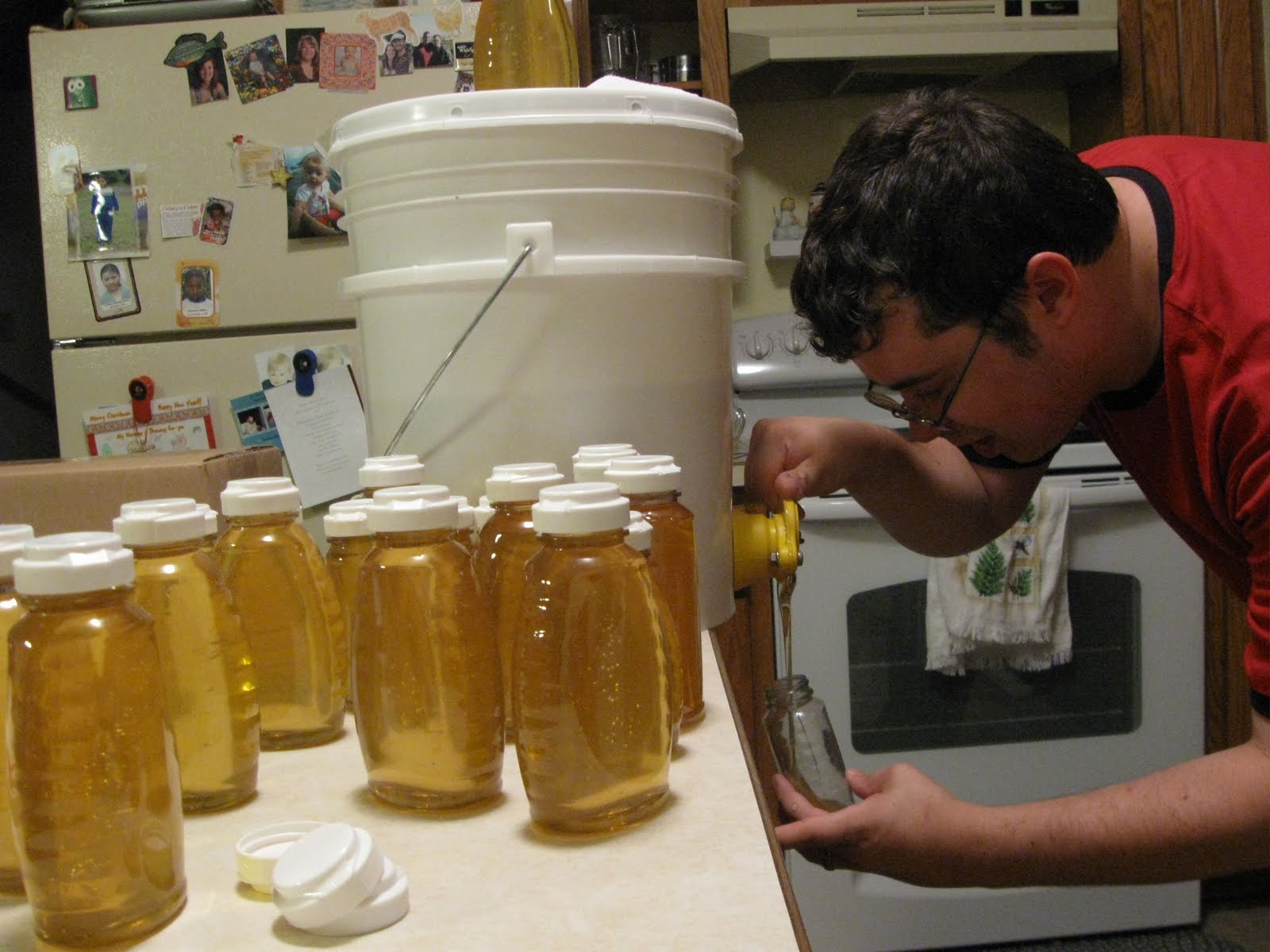 After getting the honey from the hive into a bucket, I needed to bottle the honey for distribution. Honey can be stored in food-grade plastic or stainless-steel air-tight containers for a very long time (centuries in some extreme cases). It shouldn't be stored in containers of other metals because the honey's acidity will oxidize the metal.
We purchased a few 5-gallon buckets and a "honey-gate" - a valve that is screwed onto a hole cut into the bottom of the bucket. The honey gate is designed so that it is easy to quickly change the flow from the bucket which allows bottle fillers (me) to avoid overflowing the bottles.
First, I put a cardboard box under the honey gate to catch all the drips. As well as the honey gate is designed, it isn't perfectly drip-free, and when dealing with honey you have to assume that everything you touch will be sticky at the end. My wife hates a sticky kitchen, and she seemed a bit relieved when she noticed that the honey was dripping into the box and not onto the floor!
I rinsed and dried the food-grade PET bottles, and then just filled them with honey up to the neck. Then I tightly screwed on the plastic cap along with a paper seal. The seal seems to have a bit of adhesive around the rim and helps to keep the jar air-tight. Finally, I wiped off each bottle to remove the honey that inevitably gets on the outside of the jar, and the honey was ready to meet a consumer!
Out of curiosity, I weighed a few of the bottles and found that I was adding more than 1/2 lb. in the 1/2 lb. bottles after subtracting out the weight of the empty bottles. I did measure my honey at only 17% water content which would make my honey slightly heavier than the 18.6% water limit for honey, but I doubt that accounts for all of the difference. Of course, honey from different locations has different proportions of different kinds of sugar as well as differing water content, so it doesn't particularly surprise me that they're a bit heavy filled up to the neck. It's also possible that I was overfilling them. While I think they look best when filled to the neck (not the brim), large operations probably use bottling machines that fill by weight -- but then they probably have bottles that are designed for their average honey density and don't have to accommodate the variation in hobby apiarists world-wide.
Subscribe to:
Posts (Atom)